Our Beliefs
- Judaism is not just a religion; it’s a spiritual culture and civilization — language, land, peoplehood, ethics, arts, history, law, folkways and beliefs, all as one evolving whole.
- Spiritual Humanistic Judaism doesn’t throw tradition out. It builds tradition around Jewish culture, democratic values and contemporary knowledge — with fresh liturgy and education.
- Jewish spirituality functions as a vehicle for human self-fulfilment. Revelation and mitzvot are human, cultural expressions, re-interpreted functionally for today.
- Jewish life is lived through “folkways,” not just commandments — holidays, home rituals, language, music, communal institutions and ethics.
- Creative Judaism. Jews should consciously re-shape tradition — liturgy, practice, institutions — so Judaism can be maximally meaningful for contemporary people.
The Purpose of Religion
The purpose of religion is to enable human fulfilment and moral growth. The validity of a religious system is demonstrated by the justice, compassion, courage and human flourishing it cultivates, individually and collectively. A religion that does not make us more capable of recognising suffering, resisting injustice, caring for other people and accepting responsibility for our actions is failing at the thing religion is for.
Yetzer Hara
This does not mean that the yetzer hara is evil. Appetite, ambition, self-interest, anger and the drive for self-preservation are not moral failures. They are among the energies by which a life is lived. Without them we would not build, create, protect ourselves, challenge oppression or pursue change. The problem is not that we possess these drives. The question is what we do with them.
Yetzer Hatov and Conscience
The yetzer hatov speaks through conscience. It calls me to consider what is right in the present moment; to pursue justice and to keep pursuing it; to practise ḥeshbon hanefesh by examining my actions and thoughts; to challenge irrational thinking; to cultivate compassion for myself and others; to care for my relationships; to discipline destructive habits; and to refuse complicity in war, exploitation, theft and collective injustice. It does not supply an infallible answer. It makes the question difficult to avoid.
The yetzer hatov is not the policeman of the yetzer hara. It does not arrive to suppress appetite or extinguish anger. It is the capacity of conscience to examine these energies, to ask what they are serving, and to direct them towards the enhancement of life.
Anger and Spiritual Discipline
Anger about homophobia, misogyny, racism, ableism and high-control religion is not a defect in spirituality. It is part of its moral content. It tells me that something is wrong, gives me energy to oppose it, and refuses to let indifference pass for serenity.
Anger can still become hatred, cruelty, vengeance or dehumanisation. Spiritual discipline does not ask us to deny our impulses or rise above our humanity. It asks us to remain answerable for what our passions become and what they do to other people.
Shabbat
Shabbat embodies this religious purpose. It is a practice of freedom: freedom from constant stimulation, consumerism, argument, unhealthy consumption and the endless circulation of distressing news and negative conversation. Shabbat sanctifies a recurring period in which we experience and cultivate a world closer to what it is capable of becoming. It is a weekly rehearsal for a repaired world.
Spirituality and Responsibility
The world is the world, and nature does what nature does. Spirituality begins in attentive participation in life as it is: in awe, gratitude, grief, joy, wonder, relationship, conscience and moral aspiration. These are dimensions of life itself, made religious through disciplined attention, Jewish practice, communal repetition and ethical consequence.
The world\u2019s moral brokenness is made by human beings. Responsibility for that brokenness belongs to us, and so does the work of repair. What humanity has shattered must be repaired through human hands.
Holiness is not freedom from human passion. It is human passion educated by conscience and held accountable to life, dignity, relationship and repair. This work is both personal and communal.
Mitzvot, Kehillah, and Repair
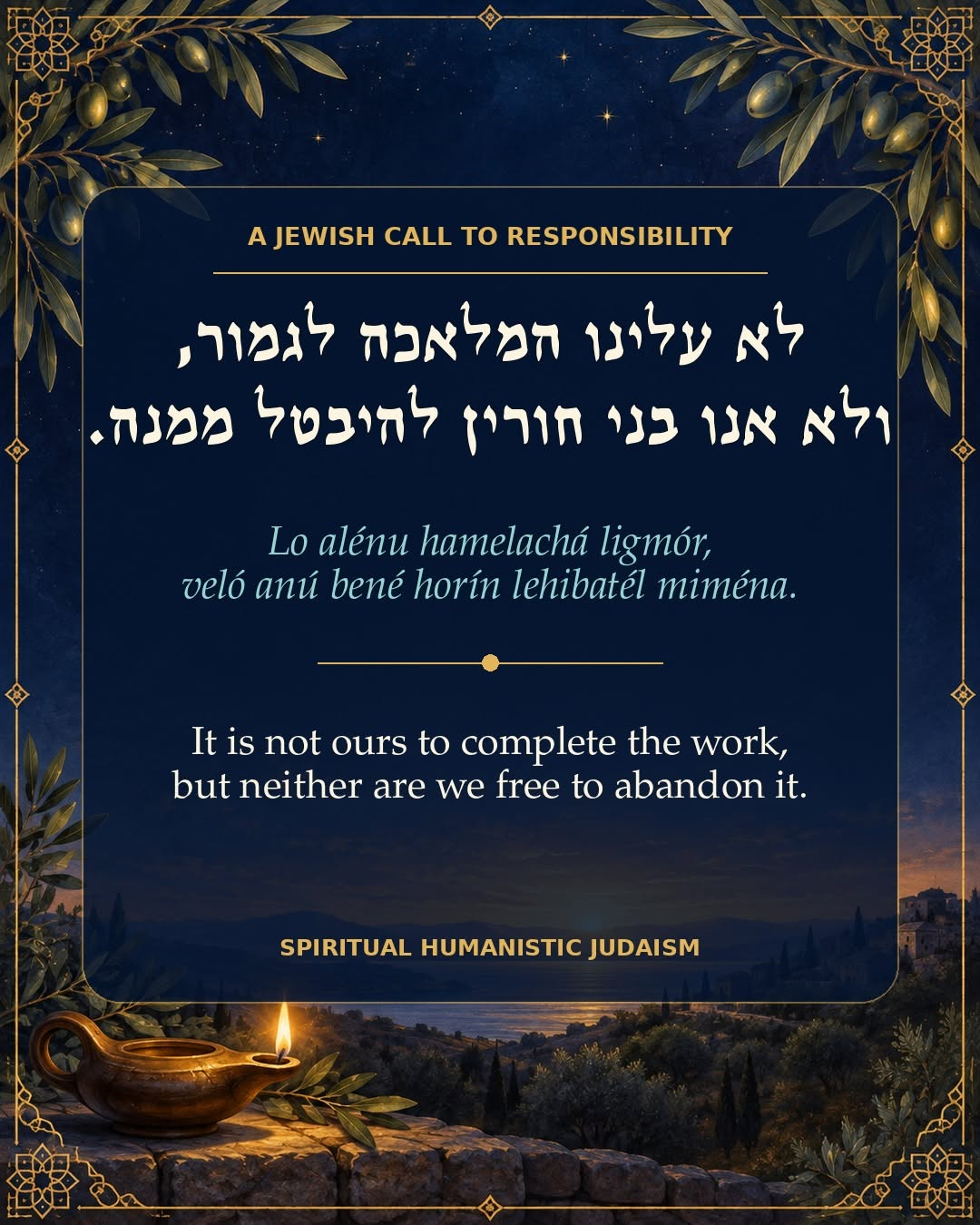
Through the mitzvah system, Jews undertake not to remain bystanders: Lo aleinu hamelakhah ligmor, velo anu b\u2019nei ḥorin lehibatel mimena — it is not ours to complete the work, but neither are we free to abandon it. Mitzvot turn ethical commitments into repeated practices. They ensure that justice, compassion and responsibility do not remain admirable nouns while daily life continues unchanged.
This is why kehillah and minyan matter. Repair is collective, although it requires the conscious attention of every individual. We constitute a community bound by practice, memory and ethical responsibility: a religious and spiritual humanistic community of Jews. We are a choosing people, living among other peoples capable of making their own sacred choices.
GOD
The concept of God has occupied Jewish thought for millennia. From the biblical narratives to the Talmud, from the philosophical writings of Maimonides and Spinoza to the reconstructionist theology of Mordecai Kaplan, Jewish thinkers have continually wrestled with what God means and how the divine relates to human life. We see ourselves as part of that long and living conversation.
What is striking about this tradition is how much it has changed over time. The God described in the stories of the patriarchs looks quite different from the God proclaimed by the prophets, and both differ considerably from the abstract, philosophical God of medieval Jewish rationalism. Add to this the contributions of modern feminist theology — which has challenged deeply embedded assumptions about gender and divine imagery — and it becomes clear that there is no single, settled Jewish understanding of God. There never has been.
New theological ideas have rarely been welcomed without resistance. Spinoza was excommunicated for views that many Jewish thinkers today consider profound and even foundational. Time and again, what one generation condemned as heresy, a later generation embraced as insight. The result is a Jewish theological landscape that is genuinely pluralistic — sometimes beautifully so, sometimes uncomfortably so.
Importantly, Jewish identity has never been defined by adherence to a particular set of beliefs. The traditional definition of who is a Jew centres on lineage and practice, not on doctrine. There is no Jewish creed that one must sign. This has always left considerable room for individuals to work out their own relationship with the concept of God, and that freedom remains central to how we understand Jewish life.
Some people assume that because our liturgy sets aside the language of a commanding, intervening God, we must be an atheist community. This is a misreading of who we are. Our approach is humanistic — meaning that we place human reason, responsibility and experience at the heart of our values — but this does not rule out belief in God. What it does rule out is a particular kind of God: one who overrides the laws of nature, intervenes in human affairs, rewards and punishes, or issues commands from beyond. A God conceived in that way sits uneasily with a worldview grounded in scientific understanding and human accountability.
There are, however, many other ways of thinking about God that fit quite naturally within a humanistic framework. A number of us hold a genuine sense of the divine — understood perhaps as the ground of existence, as the force behind meaning and connection, or simply as something that resists easy definition but feels real nonetheless. What unites these views is that they do not place final authority outside of human beings, and they do not ask us to suspend our reason or ignore what we know about how the world works.
Others among us find that the word God does not speak to their experience at all, and they are equally at home here. For them, Jewish identity is rooted not in theology but in history, community, culture and shared ethical commitments.
Neither group is more authentically Jewish than the other. What we share is a commitment to thinking honestly — about ourselves, about our world, and about the questions that have animated Jewish life across the centuries. Our services and liturgy are shaped by that commitment. They are designed not to hand answers down, but to create space for genuine reflection.
This means that God is very much a live topic here — discussed, questioned and approached from many angles. We believe that open inquiry is not a threat to faith or to Jewish identity; it is an expression of the best of our tradition. The goal is not consensus on what to believe, but a shared willingness to keep asking, and to do so together as a Jewish community.
This reflection draws on kindred thinking from Beit Kaplan, another Spiritual Humanistic community.