
מוּסָר · מִדּוֹת
The Jewish discipline of becoming the person you mean to be
Attention · Character · Return
Judaism has always cared less about what a person believes than about how a person lives. Mussar is the part of the tradition that takes that seriously as a practice: a patient, unglamorous discipline for working on one’s own character, one quality at a time. The qualities it works on are called middot.
What is Mussar?
Mussar (מוּסָר) means instruction, discipline or correction. The word appears in Proverbs — “Hear, my child, the instruction of your father” — and it came to name a whole literature of ethical and spiritual self-examination: Baḥya ibn Paquda’s Duties of the Heart in the eleventh century, Moshe Ḥayim Luzzatto’s Path of the Upright in 1740, and Menaḥem Mendel Lefin’s Ḥeshbon HaNefesh of 1808, which set out thirteen qualities to be worked on in weekly rotation.
In the 1840s Rabbi Israel Salanter turned that literature into a movement in Lithuania. He saw that people could know exactly what is right and still not do it, because knowledge does not reach the habits and reactions that actually govern behaviour. Mussar was his answer: small groups, slow and repeated study, contemplative practices, and an honest daily accounting of what one had done. In our own time it has been renewed for a much wider audience by teachers such as Alan Morinis and Rabbi Ira Stone.
What are middot?
מִדָּה
Middah · a measureA middah is a quality of character — patience, humility, gratitude, courage, truthfulness, generosity, restraint. The word literally means “measure”.
שְׁבִיל הַזָּהָב
The right measureNo middah is simply good or bad. Humility too weak becomes arrogance; too strong, it becomes vanishing when you are needed. The work is balance.
תִּרְגּוּל
A capacity, not a possessionWe do not simply have or lack patience. It is a human capacity that can be strengthened, balanced and practised, as a muscle can.
נֶפֶשׁ
A personal curriculumEveryone’s measures differ. The places where you repeatedly stumble are not a verdict on you; they show you what your own work is.
The inherited method is simple and has hardly changed in two centuries. Take one middah at a time, for a fixed period. Attach a specific practice to it. Keep a written account of how the practice went. Then, later, return to the same quality as a person who has changed.
Why Mussar matters to Spiritual Humanistic Judaism
- It asks who we are becoming, not what we must believe. The middot are human capacities, and the work on them happens in human lives. Nothing in the method depends on a supernatural God — Lefin built his own system partly on Benjamin Franklin’s list of virtues. Mussar is one of the richest parts of the tradition that a naturalistic Judaism can take up whole.
- It is where godliness becomes practice. The rabbis taught that as God is compassionate, so you be compassionate. Harold Schulweis turned that around: what is sacred are the qualities themselves — compassion, justice, truth, lovingkindness — wherever human beings make them real. If the divine lives in the attributes, then Mussar, the cultivation of attributes, is the heart of religious life.
- It supplies what the interior life was missing. Mordecai Kaplan wrote beautifully about piety, wonder, hope and the higher self, but left no method for acquiring them. Mussar is that method. Each of those qualities is a middah that can be named, practised and accounted for.
- It is shared, not private. On its own, character work can shrink into self-improvement with a Jewish label. We work the same middah together, speak about it with one another, and say it aloud in prayer: each blessing in Tefilotenu names a good and commits the speaker to it, which is the form a middah requires.
- It is tested on a weekday. A quality counts by what it produces in conduct — at work, at home, in the queue, in an argument — not by how it feels in meditation or in services.
- It is practised without shame. Historical Mussar has a severe, ascetic streak that the method does not need. The yetzer hara is not the enemy, and a practice that becomes a machine for self-reproach has failed on its own terms. What Mussar offers is honest attention, and with it the possibility of teshuvá — return.
The measure of practice is the weekday.
The Daily Practice of Middot
A Spiritual Humanistic Jewish discipline of attention, character and return, in eight steps. Choose one middah for the week, give it a short phrase, begin each morning with it, sit with shemá — listen — and review the day before bed.






Tap any card to open it full size. You are welcome to save and share them.
Read the practice as text
1. Choose a middah
Choose one quality of character to cultivate during the week: patience, courage, humility, gratitude, compassion, truthfulness or restraint. A middah is not something we simply possess or lack. It is a human capacity that can be strengthened, balanced and practised.
2. Write a daily reminder
Create a short phrase expressing the quality you want to cultivate. It may come from Jewish tradition or from your own experience. There is nothing magical in the words. What matters is that they express the ideal clearly and honestly — for example: “I matter, but I am not the centre of everything.”
3. Begin the morning intentionally
Before the day takes hold, read the phrase slowly and with full attention. Say it aloud, repeat it or chant it until it becomes vivid in your mind: “This is the quality I will try to practise today.” Begin with kavaná — clear intention.
4. Meditate on shemá
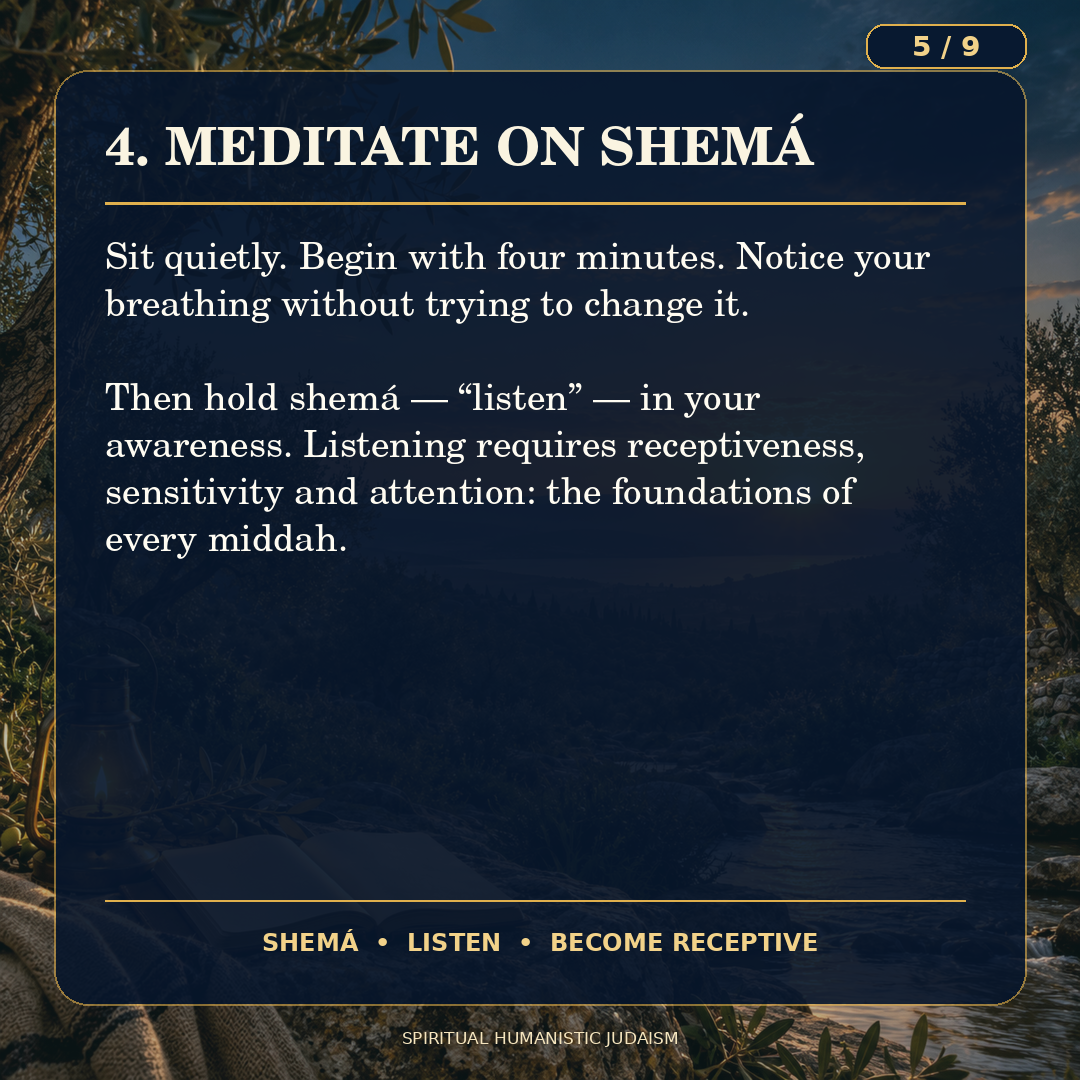
Sit quietly. Begin with four minutes. Notice your breathing without trying to change it. Then hold shemá — “listen” — in your awareness. Listening requires receptiveness, sensitivity and attention: the foundations of every middah.
5. Notice and return
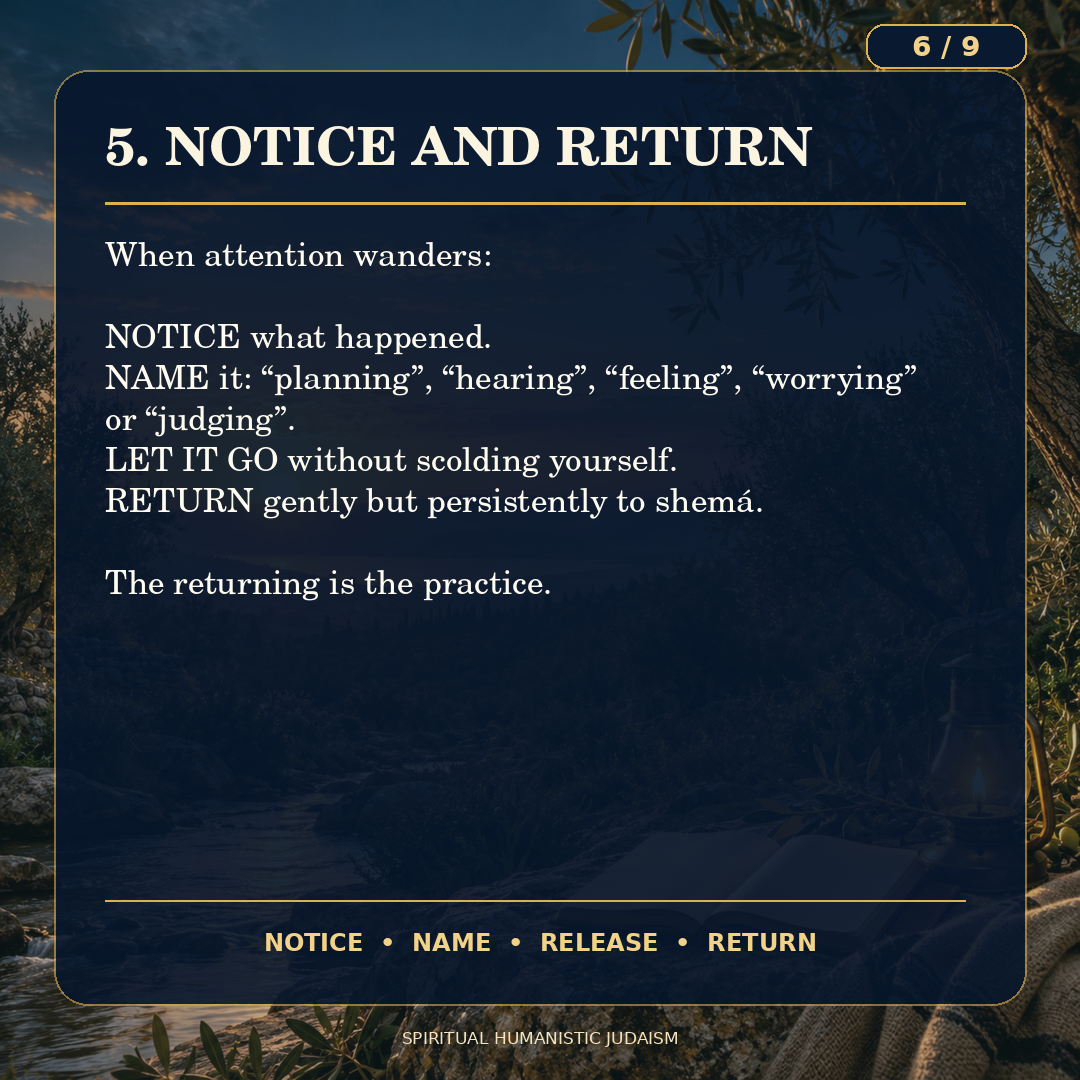
When attention wanders: notice what happened; name it — “planning”, “hearing”, “feeling”, “worrying” or “judging”; let it go without scolding yourself; return gently but persistently to shemá. The returning is the practice.
6. Learn from distraction
Distraction is not only failure. It can reveal your curriculum of character. Planning may uncover anxiety. Anger may reveal wounded dignity. Jealousy may expose insecurity. Judgement may disclose fear or pride. Notice during meditation; reflect afterwards.
7. Practise during the day
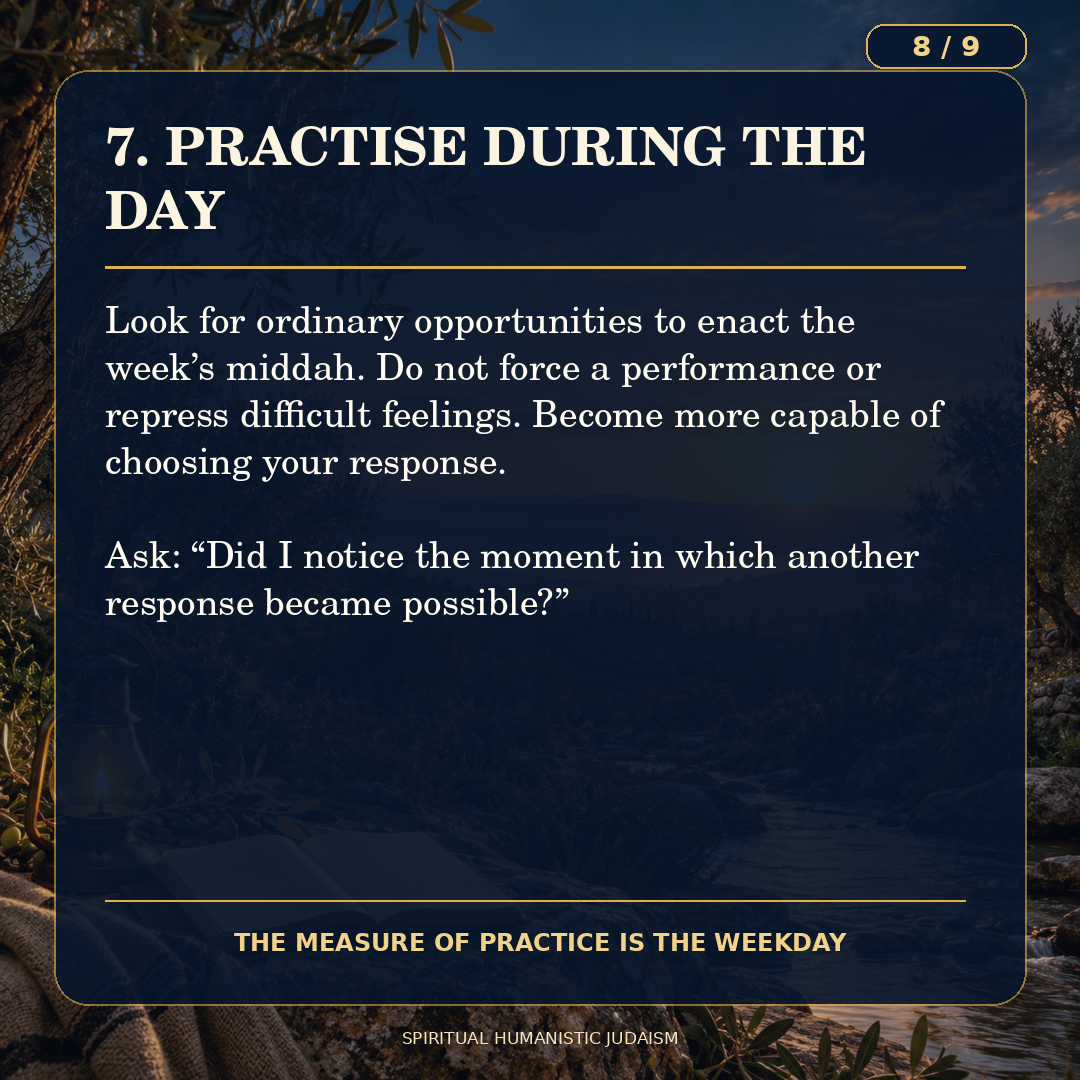
Look for ordinary opportunities to enact the week’s middah. Do not force a performance or repress difficult feelings. Become more capable of choosing your response. Ask: “Did I notice the moment in which another response became possible?”
8. Review the day
Before bed, practise ḥeshbon hanéfesh, the accounting of the soul: When did this middah become relevant? What did I feel and do? What prevented me acting as intended? What might I practise tomorrow? This is not a trial or an exercise in shame. It is honest attention that makes teshuvá possible.
Choose · Attend · Practise · Reflect · Begin again